SCULPTURE
SCULPTURE
PAINT & INK
PAINT & INK
PAINT & INK
CV
CV
CV
THE NATURE OF WANTING - ARTIST STATEMENT
‘The Nature of Wanting’ is a body of work that addresses the unsustainable consumption of the human race. As a species people continuously process resources of social, environmental and economic value with little regard for the future. Materials are extracted, refined and transformed into fleeting 'objects of desire'. Though a face-paced lifestyle only encourages a focus on the final product, their consumers have become detached from the process that created them. Resulting in a reduced appreciation between these 'objects of desire' and the methods used to create them. A disassociation that contributes to a wasteful attitude towards both labour and environmental resources.
This exhibition explores human body as a machine that seeks out and consumes through unsustainable resource gathering processes. Representing all 'objects of desire' is a small stepped pyramid that appears in several of the works. Whether through representation or suggestion, human presence provides context and narrative for this pyramid to generate discussion of humanity’s consumption habits.
THE NATURE OF WANTING - ARTIST STATEMENT
‘The Nature of Wanting’ is a body of work that addresses the unsustainable consumption of the human race. As a species people continuously process resources of social, environmental and economic value with little regard for the future. Materials are extracted, refined and transformed into fleeting 'objects of desire'. Though a face-paced lifestyle only encourages a focus on the final product, their consumers have become detached from the process that created them. Resulting in a reduced appreciation between these 'objects of desire' and the methods used to create them. A disassociation that contributes to a wasteful attitude towards both labour and environmental resources.
This exhibition explores human body as a machine that seeks out and consumes through unsustainable resource gathering processes. Representing all 'objects of desire' is a small stepped pyramid that appears in several of the works. Whether through representation or suggestion, human presence provides context and narrative for this pyramid to generate discussion of humanity’s consumption habits.
THE NATURE OF WANTING - ARTIST STATEMENT
‘The Nature of Wanting’ is a body of work that addresses the unsustainable consumption of the human race. As a species people continuously process resources of social, environmental and economic value with little regard for the future. Materials are extracted, refined and transformed into fleeting 'objects of desire'. Though a face-paced lifestyle only encourages a focus on the final product, their consumers have become detached from the process that created them. Resulting in a reduced appreciation between these 'objects of desire' and the methods used to create them. A disassociation that contributes to a wasteful attitude towards both labour and environmental resources.
This exhibition explores human body as a machine that seeks out and consumes through unsustainable resource gathering processes. Representing all 'objects of desire' is a small stepped pyramid that appears in several of the works. Whether through representation or suggestion, human presence provides context and narrative for this pyramid to generate discussion of humanity’s consumption habits.
Harrison Waed See


REDACTION TOOLKIT (2026)
EXHIBITED @ LIGHT WORKS GALLERY (WA), DEVELOPED FROM RESIDENCY @ PERTH INSTITUTE OF CONTEMPORY ART
STIRLING KANE
HARRISON WAED SEE
JORDEE STEWART
REDACTION TOOLKIT is a collaborative, artistic response to real-world conflict and disaster contexts, specifically, the social and cultural phenomena that arise in their aftermath. This exhibition represents an ongoing, material dialogue between Jacob Canet-Gibson, Stirling Kain, Harrison Waed See, and Jordee Stewart. The themes explored in REDACTION TOOLKIT are prompted by an amalgam of real-word contexts. However, as artists collaborated, each responded to their own speculative contexts developed from a unique mix of the personally-sensed and experienced; as well as historical and currently-emerging events. Importantly, none of the artists have explicitly revealed the nature of these speculative contexts to their collaborators. This ambiguity is a type of self-redaction that underpins their fragmented, adaptive, and exploratory ways of working.
SELECTED IMAGES FROM EXHIBITION


'Redaction’ (or redacting) as a concept is integral, and prompted other verbs—censoring, celebrating, mythologising, silencing, forgetting, venerating, reconciling, memorialising, denying, distorting, and fragmenting—informed by how communities make sense of their past and present. In this way, redacting, along with these other verbs, are explored as subject, material, and method in the studio.
The material and conceptual positions through which collaboration emerged included: optical lens technologies; data art and sonification; historical and contemporary photographic workflows; figurative painting and drawing; soft sculpture; and graphic design. The resulting solo and collaborative works arose reciprocally and rhizomatically as these diverse positions intersected. This collaborative dialogue mirrors the plurality of ways people respond to conflict and disaster contexts, and has led to an expanding array of novel, and heterogeneous art methodologies.
SELECTED IMAGES FROM RESIDENCY


_GRAPHY (2025) examines the relationship between the material contexts of optical lens technologies and painting. Departing from the initial notion that the suffix graphy denotes the process or form of drawing, writing, representing, recording, describing, etc., or an art or science concerned with such a process. The work delves into varying interactions and intersections of “painting with light” and painterly mark-making (insert your real terms here). The results, divided into four unexplained categories, arrive at ambiguous, disquieting, results. Photographic grain mirrors painted texture; the sonification of digital photographic data and recordings of brushstrokes both can leveraged to produce harsh noise; and each medium distils into blocks of shape and tone. _GRAPHY (2025) is part of a series of ongoing collaborations between Dr Jacob Canet-Gibson and Dr Harrison Waed See.
(IN)VULNERABLE (2021–2022)
EXHIBITED AT FRINGE WORLD FESTIVAL (COLLABORATIVE EXHIBITION: POLOPHONY) @ GALLERY 25 (EDITH COWAN UNIVERSITY, WA)
HARRISON WAED SEE (VISUAL ARTIST)
BRAD NISBET (VIRTUAL REALITY)
DECLAN BROOKS-CREW (CRIMINOLOGY)
This artwork represents a convergence between visual art, criminology, and media studies touching on masculinity and hero culture within paramilitary structures. Specifically with a focus on police, this interdisciplinary installation analogises the ideals symbolised by the heroic brotherhoods of European knights, experimenting with juxtapositions of expectations and realities within contemporary policing culture. Through augmented reality, a dialogue between stoic protector and vulnerable public servant reveals itself. This plays on the timeless, but problematic dynamic between protector and protected—between police officers and civilians—as one group ideally shields the other against the dangers of the world. A dynamic that absorbs its elite members into the ideals of a greater cause while relinquishing the nuances of individuality behind a symbolic uniform; individuality absorbed into the crude meta-narrative of good vs evil. An enduring narrative within European legend where valiant knights are subverted by temptation, greed or betrayal; a duality between the ideals of a group and the inherent vulnerability of the individual. A duality reflected in the imposing stature of the installation’s figures and the materials used in their construction.
ALL PHOTOGRAPHS BY MARNIE RICHARDSON 2021

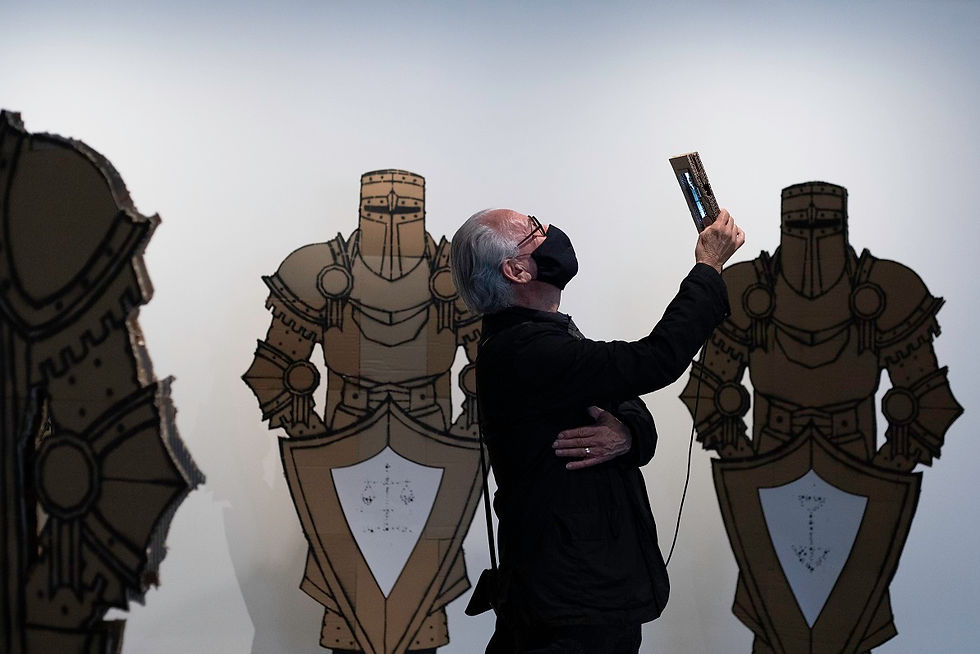


Harrison Waed See, Brad Nisbet, & Declan Brooks-Crew, 2021 (in Karali et al., 2021), IN_ VULNERABLE, cardboard, acrylic paint, wood, cast iron weights and augmented reality (AR) smart device, dimensions variable.
INTERMISSION (2020)
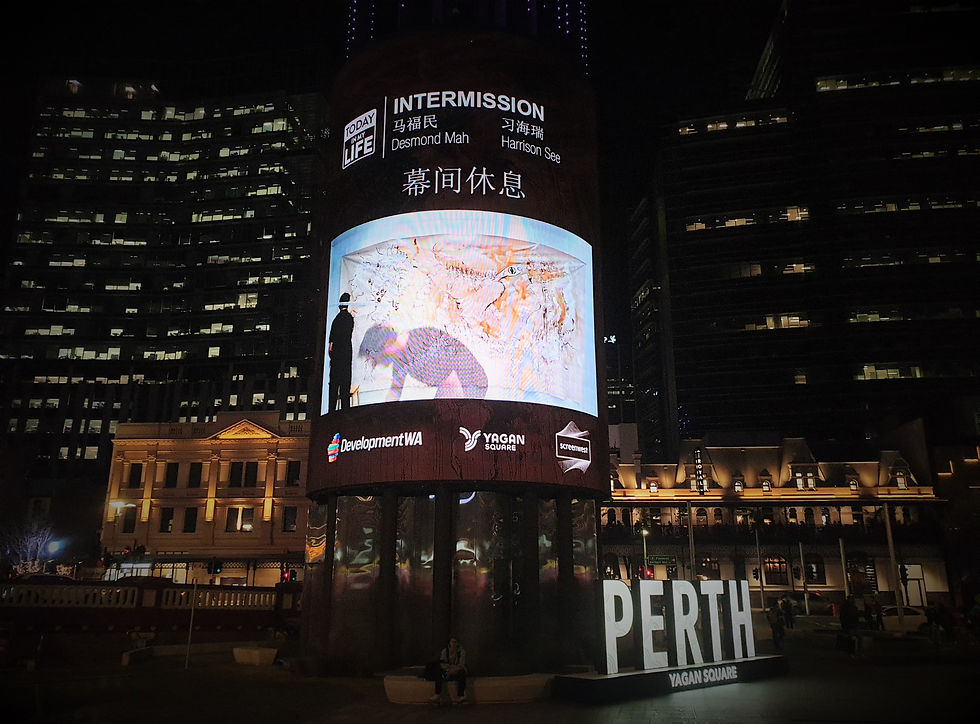
COLLABORATIVE PAINTING PERFORMANCE (2020) @ YAGAN SQUARE (TODAY IN MY LIFE PROJECT) PERTH, WA)
While maintaining social distancing, contemporary painters Harrison Waed See and Desmond Mah collaborate together creating a large impromptu painting. During this time-lapsed performative painting session Mah and See both draw on cultural iconography as they apply inks, gesso and soy sauce, reworking their own, and each others’ imagery until a conclusion is reached. While painting, the two Perth-based artists improvise a story examining their hybrid cultural identities.

A PLACE WE CALL HOME (2020)
COLLABORATIVE EXHIBITION @ STALA CONTEMPORARY (WEST PERTH, WA)
AASIYA EVANS, DESMOND MAH, & HARRISON WAED SEE,
Aasiya Evans, Desmond Mah & Harrison Waed See represent three culturally diverse artists working across different multidisciplinary oeuvres of print and paint reflect on complex issues of identity through a range of personal/spiritual, political and social narratives. A collaborative exhibition that explores an inter-cultural and inter-connected approach as they reflect on their experiences of life in Australia. Bringing into question cultural connectivities and divisions that reveal the importance of discourse pertinent to Perth’s divergent cultural, academic and social communities. Themes especially relevant during times of global crisis such as the COVID-19 pandemic.
Supported through funding from the Department of Local Government Sport and Cultural Industries (WA).


Harrison Waed See and Desmond Mah, 2020–2021 (in Evans, Mah & See, 2021), The Monsters We Battled,
gesso, ink and soy sauce on loose canvas, 210cm x 410cm
FICTIONING FAMILY HISTORIES (2020–2021)
HARRISON WAED SEE & MAYA YUSSOF
As a form of cultural exchange through shared art practice, See and Yussof brought to the studio photocopies of family photos running back through numerous generations. They then cut, tore, and collaged these photos, composing hybrid fictional scenes that intermingled our two respective lineages. As they collaged, we used paint and charcoal to extend and stitch these fragments together into a single haptic tapestry that wove together moments separated by different temporalities, and often different continents. These fragments clashed across fashions, occasions, and circumstances, together with conflicting scales, perspectives, angles, and colour ranges.


Harrison Waed See and Maya Yussof, 2020 [faces deidentified]
collage, charcoal and acrylic on studio wall, dimensions variable.